
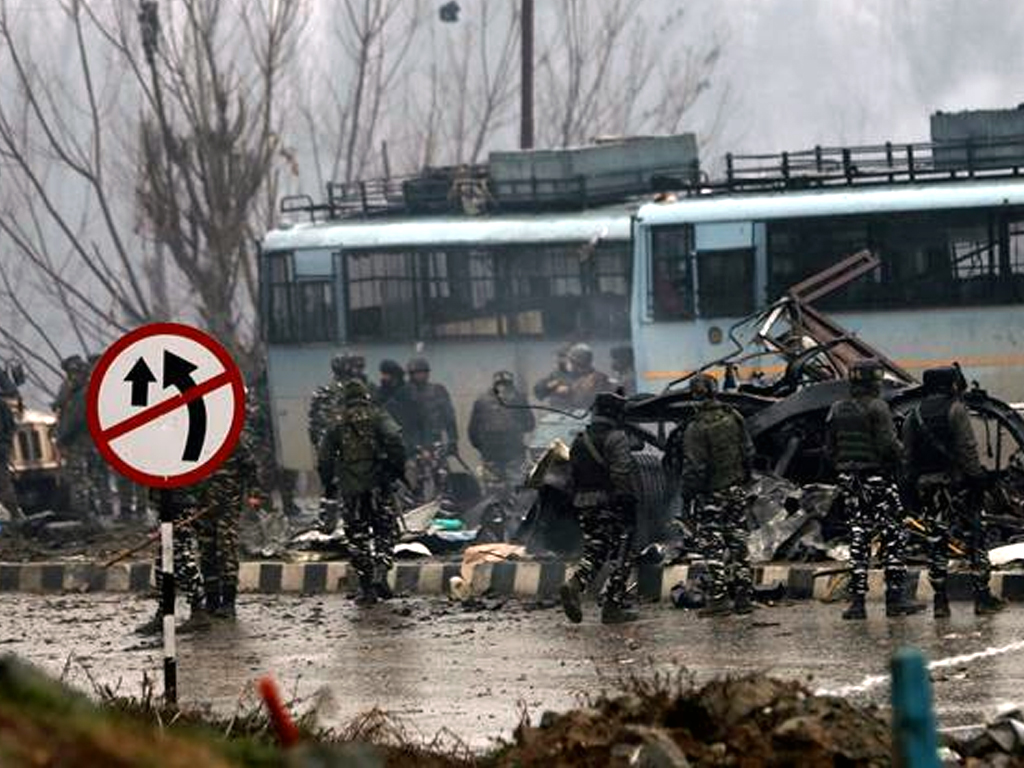
There have been occasional spurts in Kashmiris' resistance against the foreign boots, and particularly so since the martyrdom of Burhan Wani in 2016. Since then there have been anti-India protests throughout the Occupied Kashmir, invariably meted out with extreme brutality by the occupational forces. If the killing of 44 paramilitary Central Reserve Police Force (CRPF) on the Jammu-Srinagar highway on Thursday was one such spurt, as yet there is no hard evidence. But the incident does have the inbuilt potential to win support, national and international, the Modi government needs as it faces an electoral contest. Even before the concerned agencies collect basic forensics of the incident, Prime Minister Narendra Modi has accused Jaish-e-Mohammad of this "heinous and despicable act" and demanded the United Nations sanctions against the outfit. India's foreign office has gone a step further; it has asked Pakistan to "stop supporting terrorists and terror groups operating from their country." Pakistan's foreign office has said that the country has always condemned acts of violence anywhere in the world, but also strongly rejected "any insinuation that sought to link the attack to Pakistan without investigations."
By now there is ample evidence suggesting that the attack on the Indian troops was carried out by the IHK-based elements of the Jaish-e-Mohammad. There is even the video showcasing the man who carried out the suicidal attack, saying "by the time this video reaches you I will be in heaven ... this is my last message for the people of Kashmir." Given the day-by-day rising incidents of brutality perpetrated by the occupying forces, this deadly response by the freedom fighters is well within the realm of possibility. Not a day passes when the Indian troops do not kill Kashmiris.
Since the outbreak of freedom struggle in 1989, this is the deadliest attack on the occupying forces. Even when it is 'owned' by an insurgent group its timing is certainly quite intriguing. Why now and not before - there are quite a few conjectures. Firstly, it happened almost on the eve of Saudi Crown Prince Mohammad bin Salman's visit to the region. Given the Chanakya-mindset of rulers in New Delhi the Jammu-Srinagar highway bloodbath may well be yet another false flag operation with a view to diverting the royal visitor's attention away from the killing fields of Kashmir. Secondly, almost coincidental to this incident were the "mysterious blasts" in Kupwara and Pulwama districts in which a teenage boy was killed and many others were injured. Resistance leader Syed Ali Gilani termed the occurrences a "well-thought-out conspiracy against the freedom struggle". And also coincidentally, the attack on troops took place on the day a complete shutdown was being observed against the Indian designs to change the demography of Occupied Kashmir by revoking Articles 35-A and 370 of the Indian constitution. One more conjecture is that Narendra Modi wanted an event that would help him showcase his muscular approach towards Pakistan as his election agenda.
In his instant reaction, the Modi government withdrew the Most Favoured Nation (MFN) trade status given to Pakistan, pledging a "strong reply for Kashmir attack". Maybe, he would go for another "surgical strike", like the one he claimed after the Uri incident. But as to what he should have done and he did not, the Hindustan Times has a word of advice for him. The newspaper warns him against a "rash response", telling him that the "politics lies at the heart of insurgency" and that his government "must pay heed to rather ominous reality of locals being willing to turn their bodies into missiles".